If you’re thinking “Vepple looks great, but how do we justify the investment?”, you’re not alone.
Across the sector, budgets are under pressure and that’s forcing universities to look much harder at where their money is going, what’s actually working, and what students genuinely engage with.
We speak to a lot of teams who are doing good digital work, but still facing familiar problems:
- High-quality content that isn’t being seen by enough prospective students
- Virtual tours that exist mainly as long-form videos, with high drop-off and provide limited analytics/insight in return
- Digital prospectuses that attract fewer interactions and provide less usable data each year
But where do you go next when it comes to seeking out the buy-in and budget to find a solution for these challenges?
A calmer way to think about investment
No university is looking for risk right now. What we consistently hear from Vepple university partners is that the reassurance comes from a few simple things:
- Students genuinely engage with it
- The data is clear and measurable
- It reduces pressure on more resource-intensive channels
- The platform is supported, maintained and improved for you
When budgets are tight, investing in something that students actually use, and that gives teams confidence in their data, becomes much easier to justify.
The rest of this article brings together insight from universities already using Vepple to show how others have evaluated the platform, implemented it, and measured the impact.
“Budgets are tight. We need to know what actually delivers.”
Kim Marchant, Marketing Manager at Anglia Ruskin University, puts it plainly:
“Budgets have been really tight across the sector. It means we’ve had to understand our suppliers much better. Not just what they do, but the value and insight they bring.”
For ARU, that means being able to trace Vepple’s role across the student journey, from initial engagement, through open days, applications and enrolments and seeing tangible results rather than surface-level metrics.
“We can drill it right down. Not just applications and enrolments, but whether students attend open days, how they engage, and how Vepple fits into our wider marketing mix.”
That ability to connect engagement with real outcomes is a recurring theme across Vepple partners.
Students want to explore immersive content, and the data reflects that
Most universities have some form of virtual tour or video content. The challenge isn’t having something, it’s whether students actually want to use it.
Vepple experiences are built around free exploration, peer-led stories and personalisation. Students are shown relevant content and then they can choose what they want to see, skip what they don’t, and spend time where they’re genuinely interested.
Vepple sees four times more pages viewed per session, when we compare it to GA4 data of university prospective student pages. That level of engagement is what unlocks stronger lead capture and better-quality data for our partners.
Abbie Thomas-Brown, Head of Content, from Birmingham City University, explains the impact clearly:
“Since introducing Vepple, we’ve seen a massive impact on our CRM data. Around 10% of our CRM users now come from Vepple, and 55% of those are completely brand new to us.”
That means Vepple isn’t just engaging students who were already in the funnel, it’s reaching people who otherwise wouldn’t have engaged at all.
“We know the people coming through Vepple have a higher chance of converting, because they’re getting a much more personalised experience.”
For teams under pressure to justify spend, that combination of engagement and data is key.
“Is this going to be a lot of work?”
It’s a fair question, especially when teams are already stretched.
One of the most common concerns we hear is that creating a virtual experience sounds time-consuming or asset-heavy. However, in practice, universities rarely start from scratch.
Reuse what you already have
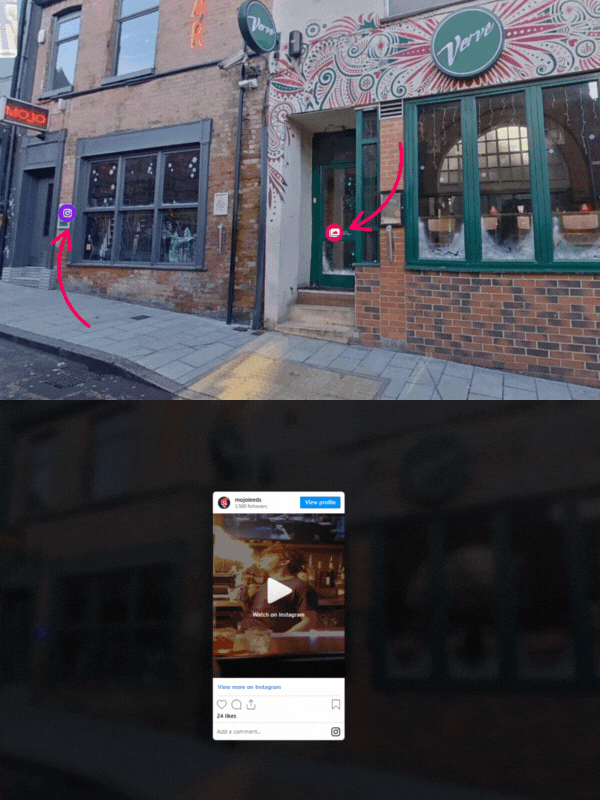
Content Spots let you bring in existing videos, social content and information points, placing them inside Guided Tours to bring additional layers (UGC style or with a more high-end finish, the choice is yours).
Edit once, update everywhere
Vepple content can be embedded across websites is even on Whatuni content hubs. Currently, Vepple content is embedded across hundreds of university course pages, meaning that universities have immersive content on their pages, while only ever having to hit ‘save’ once.
Support when you need it
For teams that want to move quickly, KickStart brings the Vepple team in as an extension of your own, from structuring content to bulk imports and templates. The average time to go live after KickStart is 21 days.
Why universities don’t just rely on videos anymore
A lot of universities still rely heavily on long-form video. While these can look impressive, they’re often high-effort to produce, difficult to update, and don’t allow students to explore freely.
Our university partners consistently tell us that the difference between a generic campus tour video, and an immersive virtual tour like Vepple, is the personalisation and control. Students can move at their own pace, explore what matters to them, and engage more deeply as a result.
Nick Holland, Head of Digital, from Manchester Metropolitan University highlights another important factor:
“Virtual tour software is specialised and complex. There are real benefits to adopting a SaaS solution, no technical debt, no ongoing maintenance worries, and continuous improvement is built in.”
“Most importantly, the experience keeps getting better even when we’re focused on other priorities.”
This is a big part of why Vepple is often seen as a safer long-term investment, particularly when budgets are tight and teams can’t afford to rebuild or maintain complex tools themselves.
“What happens to the prospectus?”
For some universities, Vepple complements the prospectus. For others, it has replaced it entirely.
UWE Bristol made the decision to replace their digital prospectus with Vepple and they’re very open about why.
“We’d seen a drop in interactions with the digital prospectus over time. As soon as we launched Vepple, engagement was much higher and people were staying on the platform to explore.”
(Charlotte Hopes, Head of Marketing, UWE Bristol)
Because Vepple is gated, the impact on lead capture was immediate:
“In the first week of Vepple being live, we captured as many leads as we previously did in a month with the digital prospectus.”
If you’re a prospective student looking for UWE’s prospectus, you won’t find it. Instead, you’ll be directed here, to a bold, confident landing page which we absolutely love! It isn’t just because they’ve replaced their prospectus with “something better” (their words, not ours).
But, by swapping a traditional prospectus for a lived experience, they’re moving away from ‘explaining’ and toward ‘immersing.’ It gives students the real stories and interactive visuals they need to make one of the biggest decisions of their lives with total clarity.

For UWE, focusing effort on the platform students were clearly engaging with simply made sense.
If you’re weighing up where to focus effort and budget next, this is a useful article to share internally, especially with stakeholders who need clarity, evidence, and reassurance.
As one last parting message, here’s one from Josie Henry, Marketing Manager at University of Huddersfield:
“We wanted something that felt modern, accessible and genuinely student-focused, but we were also careful with our budget. We did our research, looked at real use cases, and felt confident that Vepple was where we’d get the most impact.”
TL;DR
Students spend more time in Vepple because they can explore freely and personalise their experience
↓
That engagement translates into stronger lead capture and better-quality CRM data
↓
Universities use Vepple to reduce reliance on underperforming tools like static prospectuses and long-form videos
↓
The platform is designed to be scalable, supported, and sustainable, even with limited internal resource on the university’s side
↓
For many universities, Vepple has become a central, dependable part of their recruitment strategy and marketing mix